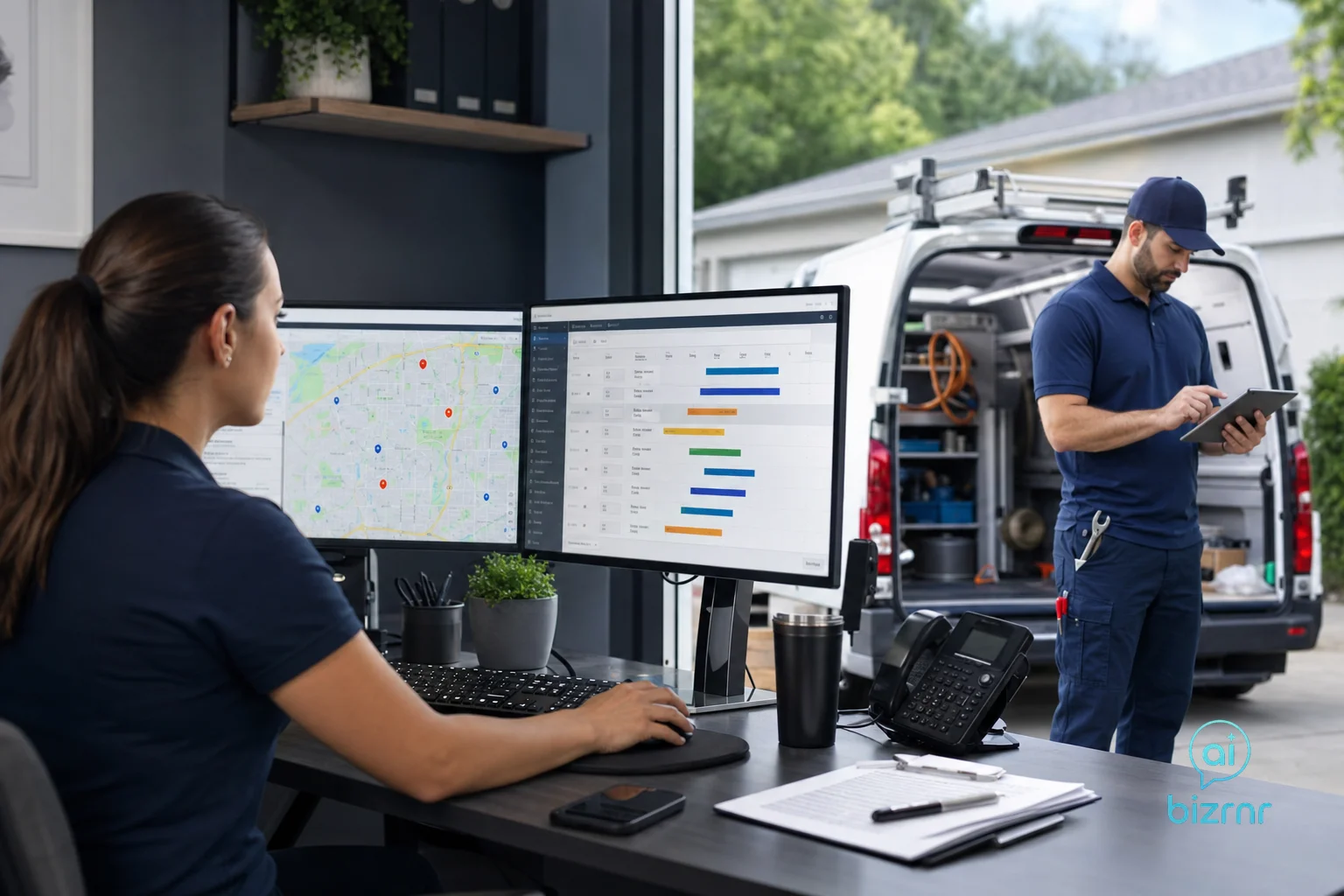
Manual dispatch is the bottleneck
Plumbing shops run on dispatch. A call comes in, someone collects the address and the problem, someone else assigns a truck, and the job gets scheduled. That chain works when the shop has a dedicated dispatcher sitting by the phone. It breaks when it does not.
Most small plumbing shops do not have a dedicated dispatcher. The owner dispatches from his truck. The office manager dispatches between billing calls. The spouse dispatches in the evening. The result is predictable: calls get missed, triage gets sloppy, and trucks end up routed inefficiently.
The 2025 data puts plumbing miss rates at 55% of inbound calls on average, with after-hours and weekend miss rates north of 85%. For a shop where a typical service ticket is $350-$600 and an emergency ticket is $1,500+, each missed call is real money.
The AI dispatch alternative
AI voice agents replace the dispatcher function for small plumbing shops. The flow:
- Call arrives at any hour. AI picks up in under 2 seconds.
- Triage questions. Is this an active leak, no water, drain backup, new install, routine? Emergency or not?
- Location and access check. Address, access instructions, pet situation, gate code.
- Calendar check. Next available truck, next available emergency slot, soonest non-emergency window.
- Booking. Direct calendar insert with truck and tech assignment if applicable.
- Text confirmation. Caller gets a text with the tech name and window.
- Owner notification. Owner gets a text or app notification with the intake details.
This runs 24/7 for a flat monthly fee. No human dispatcher. No missed after-hours emergency calls.
Dispatch vs. manual side by side
| Manual dispatch | AI dispatch | |
|---|---|---|
| Coverage | Business hours (if staffed) | 24/7 |
| Pickup time | 3-5 rings (if picked up) | Under 2 seconds |
| Miss rate | ~55% average | ~3% |
| Cost | Verify the current staffing cost | BizRnR starts at $99/month; verify current inclusions |
| Weekend handling | Voicemail or on-call | Live AI + tech handoff |
| Consistency | Varies by person | Same every call |
| Booking lag | Call back to schedule | Live booking |
| Overflow handling | Dropped | Infinite parallel |
The only column where manual dispatch wins is "judgment calls on unusual situations." For the 95% of calls that follow a standard pattern, AI wins on every metric.
What an AI dispatch flow looks like by call type
Emergency (active leak, no water, flood):
- AI triages, collects address
- Pages on-call tech by phone and SMS with intake details
- Gives caller ETA based on tech location
- Books follow-up if needed
Same-day service (running leak, drain backup, broken fixture):
- AI books next available same-day slot
- Sends tech details to caller
- Calendars the job
Scheduled service (new install, rough-in, replacement):
- AI books standard scheduling slot
- Collects prep details (unit brand, existing system)
- Sends prep email
Quote request (new water heater, bathroom remodel):
- AI books consultation slot
- Collects pre-work info for the estimator
- Flags to owner if it is a large-ticket quote
Templates ship with all four flows pre-built. For a walkthrough, see the plumbing AI voice agent page.
Where manual dispatch still wins
Three scenarios where a small plumbing shop should keep a human in the dispatch loop:
Multi-truck routing optimization. If your shop runs 5+ trucks and optimizes routes by zone throughout the day, AI is an intake layer but not a route optimizer. Pair it with a dispatch system like ServiceTitan.
Existing-customer relationship calls. Long-time customers who always ask for a specific tech — a human picks up the relationship nuance better.
Unusual emergencies. Burst main, sewage backup with health implications, flood damage — AI can triage, but a human on the dispatch seat handles edge cases faster.
For most one- to five-truck shops, AI handles 90%+ of dispatch cleanly. The owner still gets pulled in for the 10%.
The cost vs. revenue math
Typical one- to three-truck plumbing shop:
- Inbound monthly calls: 200
- Missed calls (55%): ~110
- Average ticket on a missed call: $400
- Typical close rate on answered calls: 30%
- Lost expected revenue per missed call: $120
- Monthly lost revenue: $13,200
- Annual lost revenue: $158,400
AI receptionist pricing and inclusions vary by provider. BizRnR publishes a $99/month starting price; verify current usage and features on each provider’s pricing page.
Payback: first week, typically first day for shops with after-hours emergency volume.
Plug your own numbers into the Missed Call ROI calculator.
What to watch for
Three gotchas plumbing shops hit in week one:
Noisy caller environments. Plumbers get called from a basement with water running. Make sure the voice model handles noisy inputs. 2025 models mostly do, but test on your own field recordings.
After-hours tech pay. AI catching more after-hours calls means more tech pages. Make sure your after-hours comp structure is set up for the higher call volume.
Truck assignment logic. AI books on the calendar. If you run a dispatch board with zone-based truck assignments, make sure the AI books into the right zone or defers assignment until a human looks.
Frequently asked questions
Can an AI voice agent handle plumbing emergencies?
Yes, with a plumbing-specific template. The AI runs emergency triage questions (active leak, standing water, no hot water, sewage backup), collects address, and either pages the on-call tech or books the next available emergency slot.
Will my customers notice it is AI?
Most will not in the first 60 seconds. Voice quality is high enough in 2025 that emergency callers rarely flag the AI. If asked directly, well-configured AI agents identify and offer to connect to a human.
Does it work with ServiceTitan or Housecall Pro?
Most major dispatch systems are supported. Verify your specific version before signing up. Integration means the AI books into the job list and assigns by zone if configured.
What happens on a real catastrophe call?
The AI triages, confirms it is an emergency, and pages the owner or on-call tech immediately by phone and SMS with the intake details. It does not just "take a message."
How much does plumbing AI dispatch cost?
AI receptionist pricing and inclusions vary by provider. BizRnR publishes a $99/month starting price; verify current usage and features on each provider’s pricing page.
Can the AI book multi-truck routes?
It can book onto the right truck/zone with correct setup, but it is not a route optimizer. For complex routing, pair AI intake with a dispatch system like ServiceTitan.
Next step
Your dispatch process is probably costing you six figures a year. An AI voice agent is $6,000 a year.
Start a free BizRnR trial — live in 60 seconds, no credit card. Or run your shop's numbers through the Missed Call ROI calculator.